
Hold the hillside through the wet season
Slope Stabilization & Erosion Control in Seattle, WA
Blankets, sprayed mulches and seed for banks, cuts and drainage channels around Puget Sound.
- We walk your property first, then put the quote in writing at no charge
- Seeding dates planned around Seattle's dry summer and wet winter
- One crew for grading, seeding and sediment control
Keeping Soil on the Slope Where It Belongs
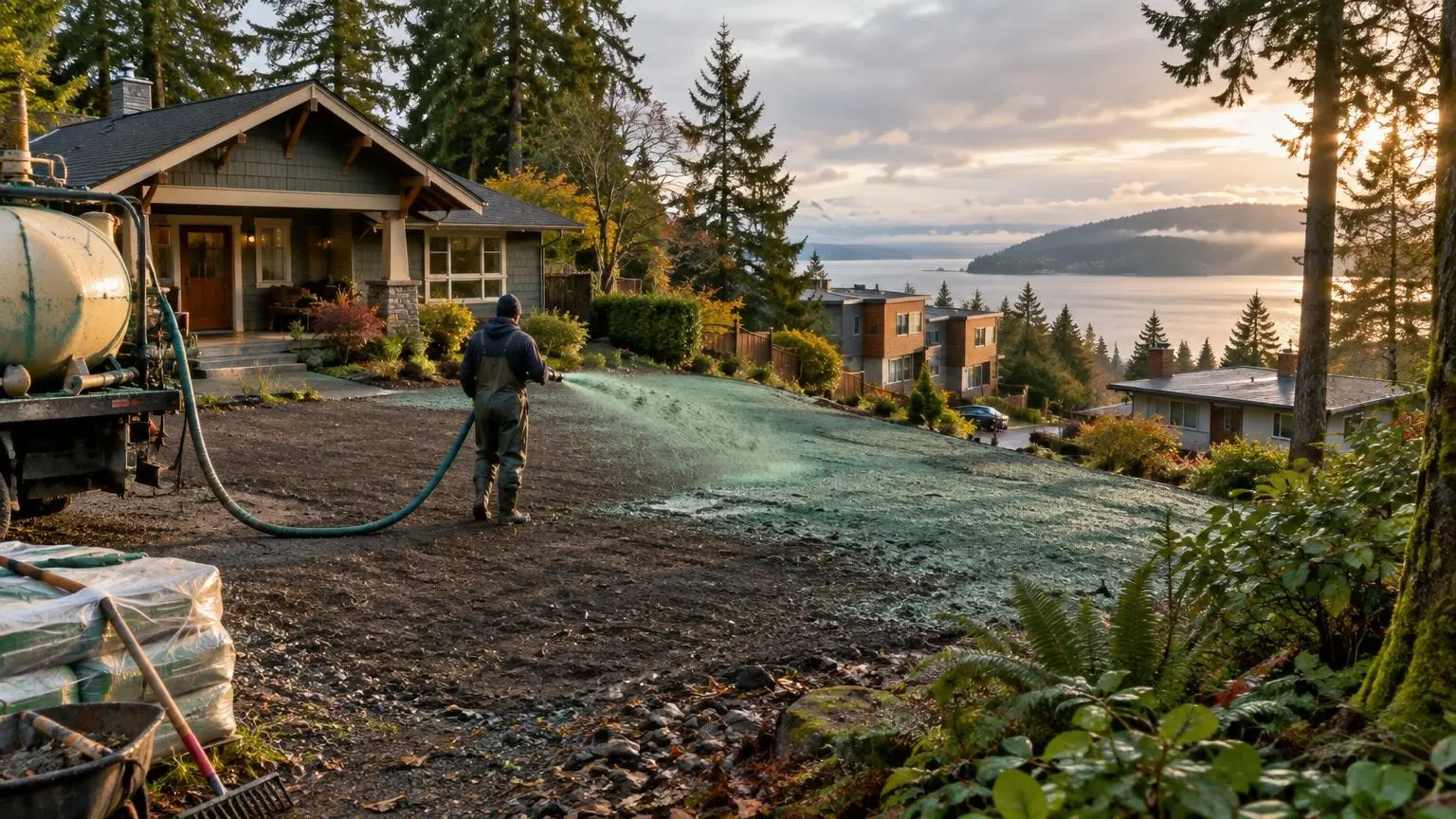
Slope stabilization and erosion control in Seattle is about getting bare soil covered before the wet season does the damage. Between October and March, steady rain falls on ground that is often already saturated near the surface, and any slope stripped by construction, a removed retaining wall or a fallen tree starts to rill and slump. Depending on the grade, we cover those slopes with rolled erosion control blankets, sprayed hydromulch or bonded fiber matrix, plus seed, so the surface is protected right away and roots take over the job as the vegetation grows.
Why slopes fail here
Across much of western Washington's uplands, soils are loose and gravelly near the top and sit over dense glacial till. The USDA's Alderwood series description notes high water movement above that dense layer and low movement within it, with a perched water table 30 to 90 centimeters down at times from December through April. Water that soaks in moves sideways along the till, and on a slope it comes out lower down, carrying soil with it. Covering the surface does not change what happens underground, but it stops raindrops and sheet flow from stripping the topsoil that seed needs.
Picking the right cover
The steeper the slope and the more water it carries, the stronger the cover needs to be.
- Hydromulch with seed: wood or paper fiber sprayed with tackifier, fine for gentle grades
- Bonded fiber matrix (BFM): a heavier sprayed mulch that dries into a continuous, porous mat, for steeper cuts where people cannot safely work
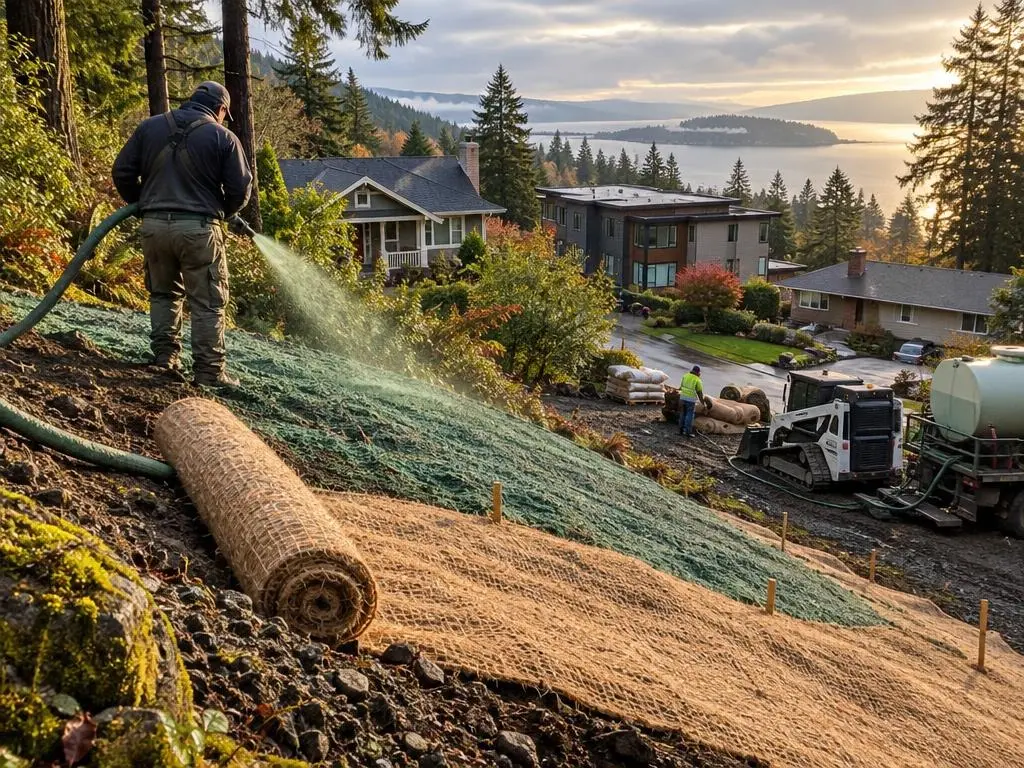
- Erosion control blankets: straw blankets, straw-coconut or all-coconut coir rolled out and stapled down, for swales, ditch lines and slopes with concentrated flow
- Seed underneath: grasses or low-growing mixes that root through the cover and hold the slope long term
Steep yards and ravines
Seattle is hilly in places, and plenty of homes sit above a ravine, a greenbelt or a steep street. On those lots we avoid heavy equipment on the slope and spray from the top or bottom instead. If a slope shows signs of deeper movement, such as cracks at the top, tilting trees or bulging at the toe, that is a job for a geotechnical engineer, and we will tell you so rather than covering it up with mulch.
Swales, ditches and drainage channels
Anywhere water concentrates, loose mulch alone tends to wash out. In swales and roadside ditches we roll blankets in the direction of flow, overlap and staple them, and seed beneath. Coir lasts longer than straw where the channel will carry water for more than one season.
Why the dry summer matters too
Erosion is a winter problem here, but summer causes its own trouble. With July averaging 0.60 inches of precipitation at Sea-Tac and August 0.97, seed sprayed on a slope in early summer may sit dormant or die before roots take hold, leaving the slope unprotected when the rain returns. If a slope must be covered in summer, we use a heavier mulch or a blanket that protects the soil on its own, and seed into it when the weather turns.
Construction slopes and permits
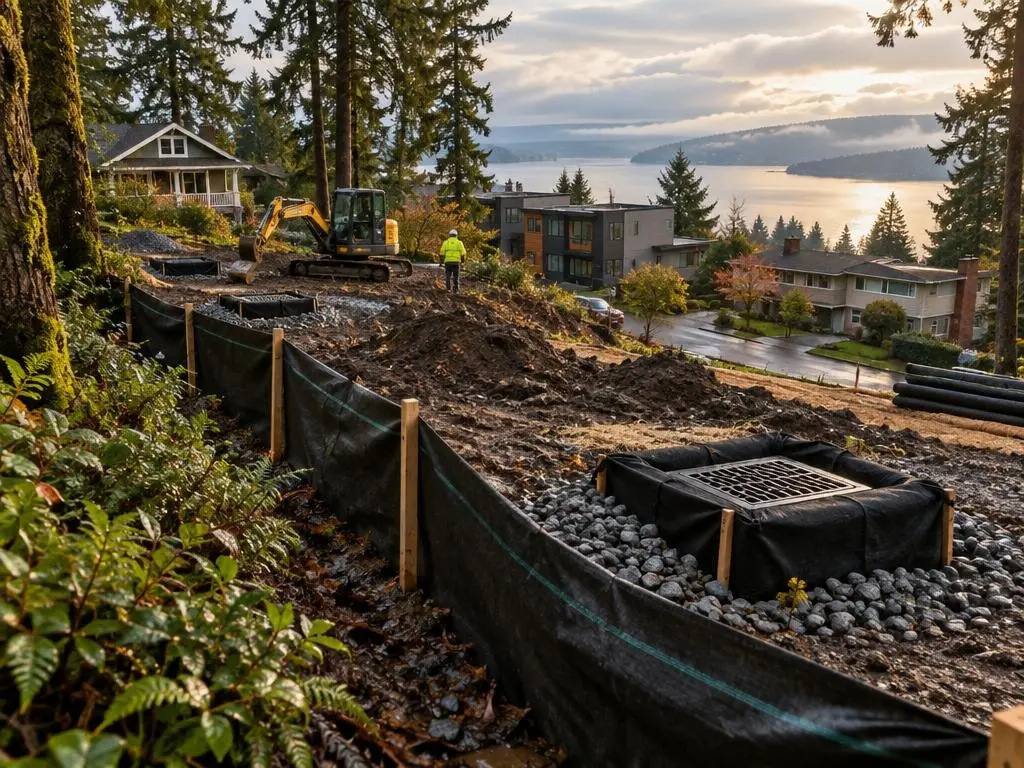
On permitted projects, slope protection is often spelled out in the construction stormwater control plan. Seattle's stormwater review applies to projects disturbing more than 5,000 square feet of land, to all grading permits, and to sites with non-disturbance areas tied to environmentally critical areas such as steep slopes and landslide-prone areas. We follow whatever product and installation detail the plan calls for.
Maintenance after installation
Blankets need to stay in contact with the soil. After the first big storms, we check for spots where water has run underneath, staples have lifted or an edge has peeled back, and we fix them before they turn into gullies. Sprayed mulch that has thinned on a high spot gets a second pass. Straw and coir are natural fibers, so once the plants have rooted, the blankets decompose and nobody has to pull them up.
Common places we stabilize
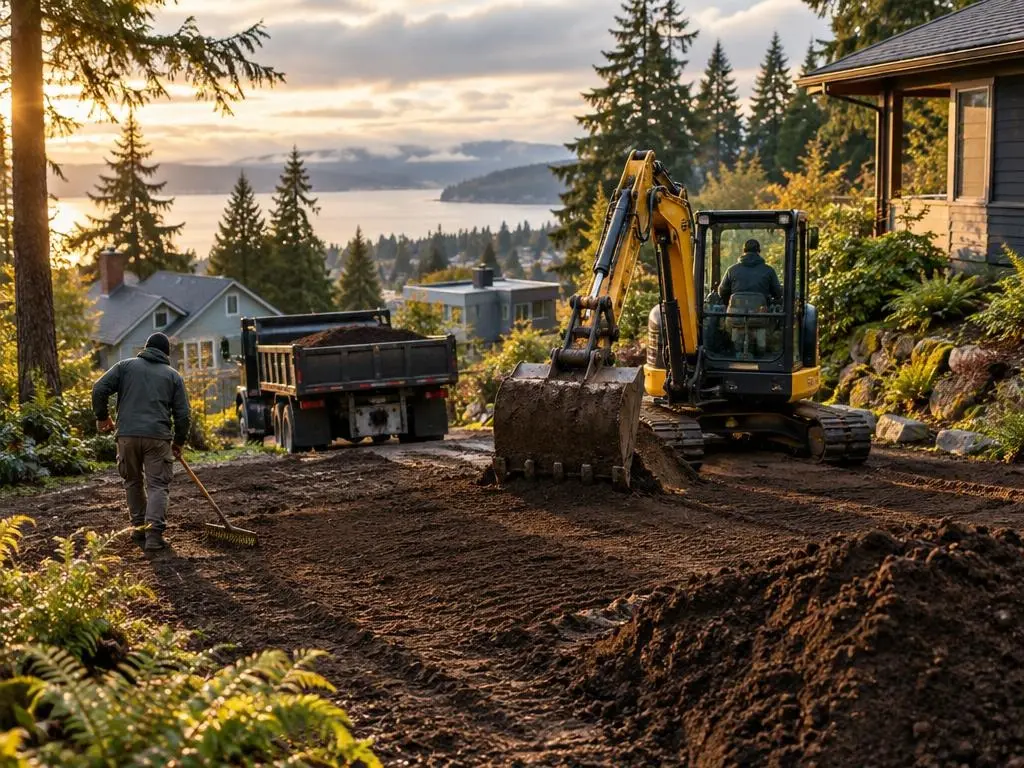
- Cut slopes behind new houses and retaining walls
- Fill slopes at the edge of driveways and building pads
- Banks above greenbelts, ravines and creeks
- Drainage swales, ditches and pond side slopes
- Areas cleared after tree removal or blackberry clearing
Hydromulch versus straw
Hand-spread straw is still common on small jobs, but it blows around, washes off steep ground and can bring weed seed. Hydraulic wood or paper fiber mulch, mixed with a tackifier, goes on evenly and bonds to the surface. That is a big part of why erosion control services on Seattle slopes lean on hydro seeding: on slopes where crews cannot safely stand, spraying from the top or bottom is the only practical way to cover the ground at all.
Timing
Erosion control work is most valuable in late summer and early fall, before the rain comes back. That said, blankets and BFM can go on in the wet season when a slope has just been exposed; waiting until spring rarely ends well. We can return to seed or overseed when conditions improve.
Erosion Control Options
Matched to slope steepness, water flow and how long the cover needs to last.
Hydromulching
Fiber mulch and tackifier sprayed with or without seed on gentle and moderate grades.
Bonded fiber matrix
A heavier sprayed mat for steep cuts and fill slopes.
Straw erosion control blankets
Short-term cover for slopes and swales while seed establishes.
Straw-coconut and coir blankets
Longer-lasting cover for channels and steeper banks.
Slope seeding
Low-mow grasses and erosion mixes that root through the cover.
Ditch and swale lining
Blankets installed with the flow, overlapped and stapled.
Erosion Control Cost References
| Item | Published range |
|---|---|
| Wood-fiber mulch sprayed on, per 1,000 square feet: state DOT unit costs (2025) | $98 |
| Hand-spread straw mulch, per 1,000 square feet: same list | $170 |
| Straw/coconut blanket (70/30), per 1,000 square feet: same list | $468 |
| Coir-only blanket, per 1,000 square feet: same list | $532 |
| Extra charge for steep ground on a home hydroseed job, per sq ft (HomeGuide) | $0.05 to $0.10 |
| Bonded fiber matrix | Quoted on site |
Agency and consumer-guide numbers for reference, not what we charge; slope length, rain timing, access and the cover your site needs set the real cost. National guide figures; your price is whatever we put in writing after measuring.
How a Slope Job Runs
1. Look at the slope
Grade, length, where water enters and leaves, and any signs of deeper movement.
2. Recommend a cover
Hydromulch, BFM, blankets or a combination, in a written estimate.
3. Prepare the surface
Rills smoothed, loose debris removed and a top ditch or diversion added if needed.
4. Install and seed
Blankets stapled or mulch sprayed, with seed placed under or in the mix.
5. Check after storms
We look at the first heavy rains' results and repair any weak spots per our agreement.
Why Choose Us for Slope Stabilization & Erosion Control
Cover matched to the slope
We do not spray light mulch where a blanket is needed.
No equipment on fragile banks
Hoses and hand work keep machines off slopes that cannot take them.
Straight talk on deeper problems
Good erosion control contractors know their limits: if it looks like a landslide rather than surface erosion, we say so.
Slope Stabilization & Erosion Control Questions
On a Seattle slope, when do you use hydromulch and when bonded fiber matrix?
Both are sprayed. Hydromulch is lighter fiber with tackifier, used on gentle to moderate grades. Bonded fiber matrix is applied heavier and dries into a continuous mat that holds on steeper slopes.
When should I use erosion control blankets instead of spray?
Where water concentrates, as in swales and ditches, or on slopes steep enough that sprayed mulch could slide. Blankets are stapled down and resist flowing water better.
Can you stabilize a slope in the middle of winter?
Yes. Blankets and heavier sprayed mulches go on in wet weather, and covering a freshly exposed slope right away is better than waiting for spring.
Will grass alone stop my hillside from sliding?
Grass and ground covers stop surface erosion. They do not fix deep slope movement, which needs an engineer's assessment.
Slope Stabilization & Erosion Control Service Areas
- Hydroseeding in Seattle, WA
- Hydroseeding in Bellevue, WA
- Hydroseeding in Redmond, WA
- Hydroseeding in Sammamish, WA
- Hydroseeding in Issaquah, WA
- Hydroseeding in Kirkland, WA
- Hydroseeding in Bothell, WA
- Hydroseeding in Kenmore, WA
- Hydroseeding in Renton, WA
- Hydroseeding in Kent, WA
- Hydroseeding in Auburn, WA
- Hydroseeding in Maple Valley, WA
- Hydroseeding in Covington, WA
- Hydroseeding in Federal Way, WA
- Hydroseeding in Puyallup, WA
- Hydroseeding in Bonney Lake, WA
- Hydroseeding in Snoqualmie, WA
- Hydroseeding in North Bend, WA
- Hydroseeding in Duvall, WA
- Hydroseeding in Enumclaw, WA
- Hydroseeding in Mill Creek, WA
- Hydroseeding in Lake Stevens, WA
- Hydroseeding in Marysville, WA
Get a Slope Stabilization & Erosion Control Estimate
Free slope and erosion control estimates around Seattle.