
Cover the dirt, close out the job
Contractor & Commercial Hydroseeding in Seattle, WA
Seeding for building lots, subdivisions, ponds and commercial landscapes, scheduled to your grading.
- We walk your property first, then put the quote in writing at no charge
- Seeding dates planned around Seattle's dry summer and wet winter
- One crew for grading, seeding and sediment control
Seeding That Keeps a Construction Schedule Moving
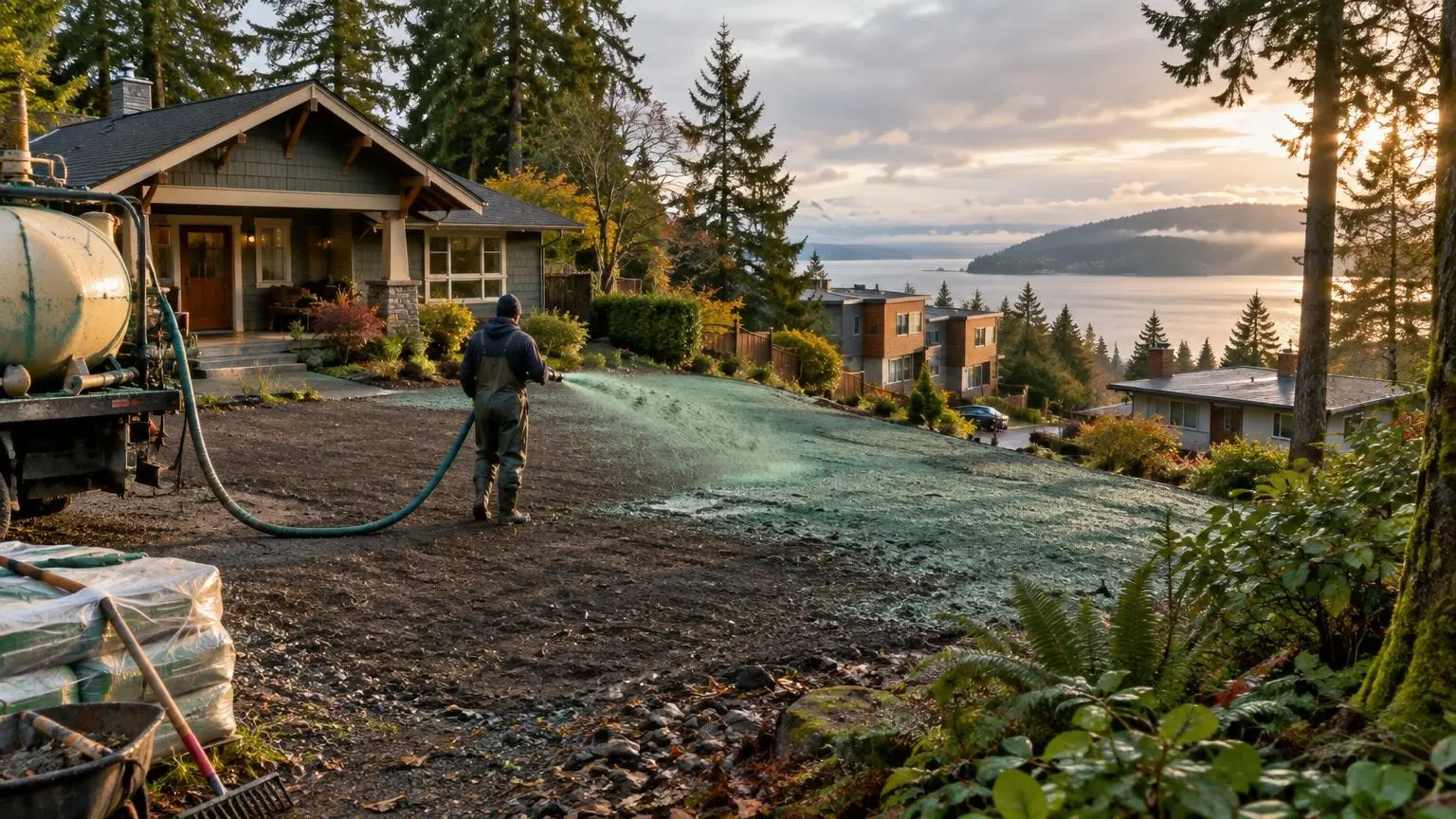
Contractor and commercial hydroseeding in Seattle covers the large, bare areas left at the end of grading: new home lots, townhome developments, detention pond banks, road shoulders, utility trenches and the open lawns around commercial buildings. We are a hydroseeding company that works to the builder's schedule. A spray rig covers ground much faster than crews spreading straw or laying sod, and the fiber mulch protects the soil from the first day, which matters when inspections and final sign-off depend on the site being stabilized.
Why timing is tight here
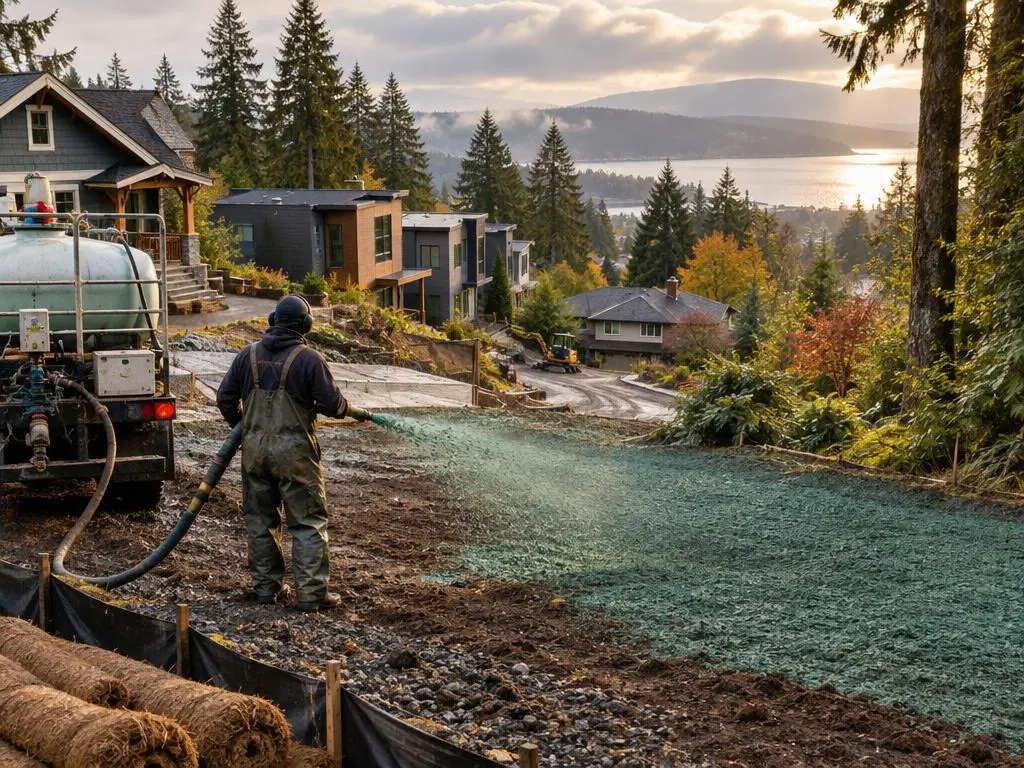
Seattle receives most of its precipitation between October and March, and Sea-Tac records measurable rain on roughly 156 days a year. A site graded in late summer that is still bare when the November rains arrive (6.31 inches in an average November) is going to shed sediment. We plan with general contractors to seed graded areas as they are finished rather than waiting for the whole site, and we add heavier hydromulch or blankets to areas that will not get seed in time.
Infill and tight sites
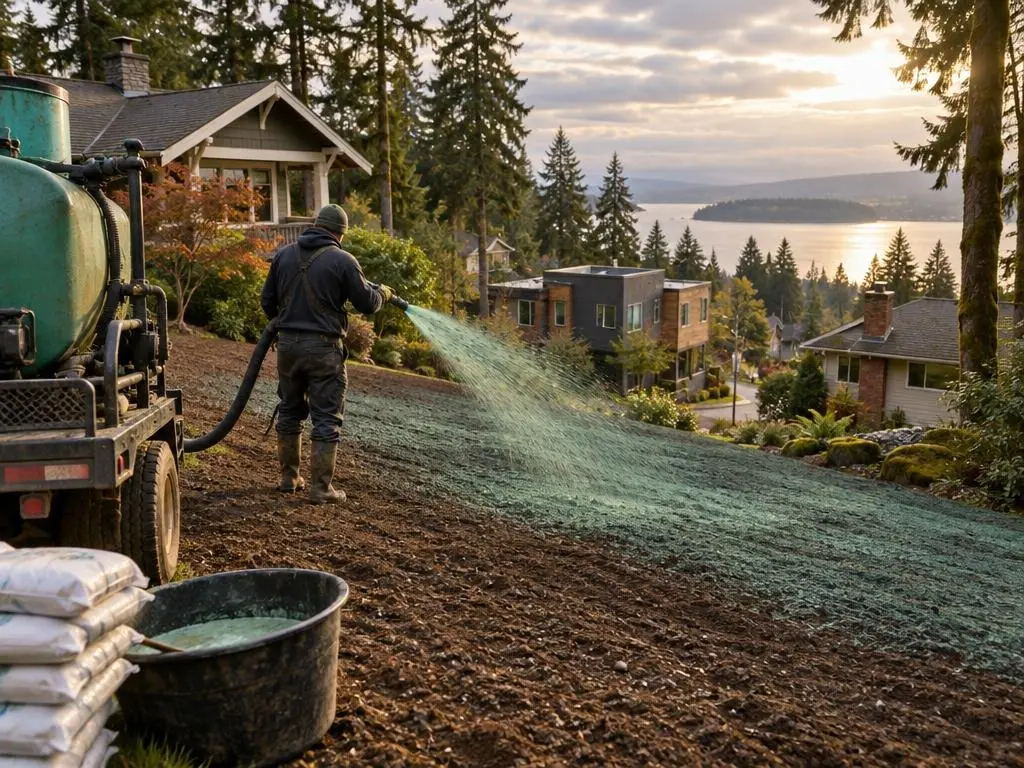
Seattle grew 21.1 percent between 2010 and 2020, and a lot of that growth landed as infill on small lots. Working off long hose runs from the truck, we can reach backyards and narrow side setbacks where equipment cannot go, and spray over finished hardscape without tearing it up. On these jobs we often handle silt fence and inlet protection as well, so one crew covers the sediment control from start to finish.
Larger open areas
For subdivisions, campuses and public projects we price by the acre and bring seed mixes that suit the use: a turf blend for lawns that will be mowed, a low-growing erosion mix for pond banks and roadsides that will not, and native-leaning blends where a landscape plan calls for them. If your specifications name a seed mix, mulch rate or tackifier, we follow them.
Working with the project plans
Seattle's stormwater rules scale with the project. Disturbing more than 5,000 square feet of land triggers stormwater review on an SDCI building or grading permit, and the city says applications with 10,000 square feet or more of land disturbing activity must be prepared by a professional engineer. Sites disturbing one acre or more also need the state Department of Ecology's Construction Stormwater General Permit. Send us the plan sheets and we will quote the seeding, mulch, blankets and perimeter controls as drawn. Among hydroseeding contractors, we try to be the ones who read the details sheet before showing up.
Seed mixes for different end uses
Not every acre on a construction job is meant to become a lawn. Areas behind homes or along a commercial frontage usually get a turf blend built around perennial ryegrass and tall fescue, the grasses WSU Extension recommends for western Washington. Pond side slopes, tracts and roadside cuts that will rarely be mowed get a tougher, lower-growing erosion mix. When the landscape plan calls for a specific seed blend, we order exactly what is specified and keep the tags for your records.
Water on site
A hydroseeding rig needs water to mix each load, and on a bare development site that can be the bottleneck. We work with what is available: a site hydrant with the purveyor's meter, a water truck, or a nearby source arranged ahead of time. Knowing the water plan before mobilization keeps the crew spraying instead of waiting, which keeps the cost per acre down.
Weather and the wet season
In Seattle, the window to establish grass before winter generally closes in fall, and November averages over 6 inches of precipitation at Sea-Tac. Sites that miss that window still need cover. We can apply hydromulch with a tackifier on its own as temporary stabilization, then return in spring to seed into it or replace it. Planning that sequence in late summer, rather than reacting in December, saves money and inspection headaches.
Touch-ups and close-out
Thin spots, tire tracks and areas disturbed by late utility work are part of every construction job. We price touch-up visits up front so there is no argument at the end about what is included, and we walk the site with your superintendent before final inspection.
Infill sites and neighbors
Most commercial and builder work inside Seattle happens next to occupied homes. We keep overspray off siding, fences, cars and windows by shielding and adjusting the nozzle, and we hose off any slurry that lands on hardscape before it dries. Truck placement is agreed in advance so we do not block driveways or alleys longer than needed. Where a site fronts a busy street, we work around traffic and parking rules for the block.
What we need from you
- Plan sheets or a site map with areas to seed marked
- Your target dates and phasing
- Water access on site or the nearest hydrant arrangement
- Who to call on site for access and staging
Commercial and Construction Work We Seed
Common project types for builders and property owners around Puget Sound.
New home and townhome lots
Final seeding around foundations once grading and utilities are done.
Subdivision common areas
Open space, tracts, swales and lot frontages seeded by the acre.
Detention and bioretention areas
Pond banks and side slopes seeded with mixes that tolerate periodic wet soil.
Road and utility corridors
Shoulders, trench lines and easements stabilized after backfill.
Commercial and campus lawns
Turf seeding for office parks, schools, churches and multifamily grounds.
Temporary stabilization
Hydromulch or quick-cover seed on areas that will be disturbed again later.
Large-Area Hydroseeding Ranges
| Item | Published range |
|---|---|
| Per acre (LawnStarter) | $2,136 to $4,897 |
| Per acre (Fixr) | $2,000 to $4,000 |
| One acre (HomeAdvisor) | $2,600 to $8,700 |
| One acre (HomeGuide) | $5,000 to $8,500 |
| North Little Rock, Arkansas public bid prices per acre (2023) | $2,595 and $3,325 |
Consumer cost-guide ranges plus one 2023 city bid, offered for scale rather than as our rates; phasing, crew access, water hookups and the materials your specs require all affect the figure. National guide figures; your price is whatever we put in writing after measuring.
How We Handle a Construction Job
1. Review the plans
We read the ESC and landscape sheets and confirm seed mix, mulch rate and areas.
2. Walk the site
Access, water, staging and phasing are agreed with your superintendent.
3. Set controls
Silt fence and inlet protection go in early if they are part of our scope.
4. Seed by phase
Areas are sprayed as grading finishes so nothing waits bare for the rains.
5. Close-out check
We revisit thin or washed spots and touch them up per the agreement.
Why Choose Us for Contractor & Commercial Hydroseeding
Plan-based quotes
We price what the drawings call for, line by line.
Phased seeding
We come back as areas finish instead of waiting for the whole site.
Long hose reach
Tight infill lots and backyards are seeded without driving on finished work.
One crew for controls and seed
Silt fence, blankets and seeding can all sit on one contract.
Contractor & Commercial Hydroseeding Questions
Do you work as a subcontractor for builders?
Yes. General contractors, developers and site-work companies make up the bulk of our commercial jobs, and we schedule around their grading.
How do you price large hydroseeding jobs?
Usually by the acre or square foot, with separate lines for blankets, silt fence and extra mobilizations. Published per-acre ranges run from about $2,000 to $8,700 depending on the source; your written quote is the price.
Can you meet a specified seed mix and mulch rate?
Yes. Send the spec and we will quote and apply to it.
What if part of the site is not ready to seed before winter?
We can cover it with hydromulch or erosion blankets as temporary stabilization and come back to seed when grading is final.
Contractor & Commercial Hydroseeding Service Areas
- Hydroseeding in Seattle, WA
- Hydroseeding in Bellevue, WA
- Hydroseeding in Redmond, WA
- Hydroseeding in Sammamish, WA
- Hydroseeding in Issaquah, WA
- Hydroseeding in Kirkland, WA
- Hydroseeding in Bothell, WA
- Hydroseeding in Kenmore, WA
- Hydroseeding in Renton, WA
- Hydroseeding in Kent, WA
- Hydroseeding in Auburn, WA
- Hydroseeding in Maple Valley, WA
- Hydroseeding in Covington, WA
- Hydroseeding in Federal Way, WA
- Hydroseeding in Puyallup, WA
- Hydroseeding in Bonney Lake, WA
- Hydroseeding in Snoqualmie, WA
- Hydroseeding in North Bend, WA
- Hydroseeding in Duvall, WA
- Hydroseeding in Enumclaw, WA
- Hydroseeding in Mill Creek, WA
- Hydroseeding in Lake Stevens, WA
- Hydroseeding in Marysville, WA
Get a Contractor & Commercial Hydroseeding Estimate
Send your plans for a free commercial hydroseeding quote.