
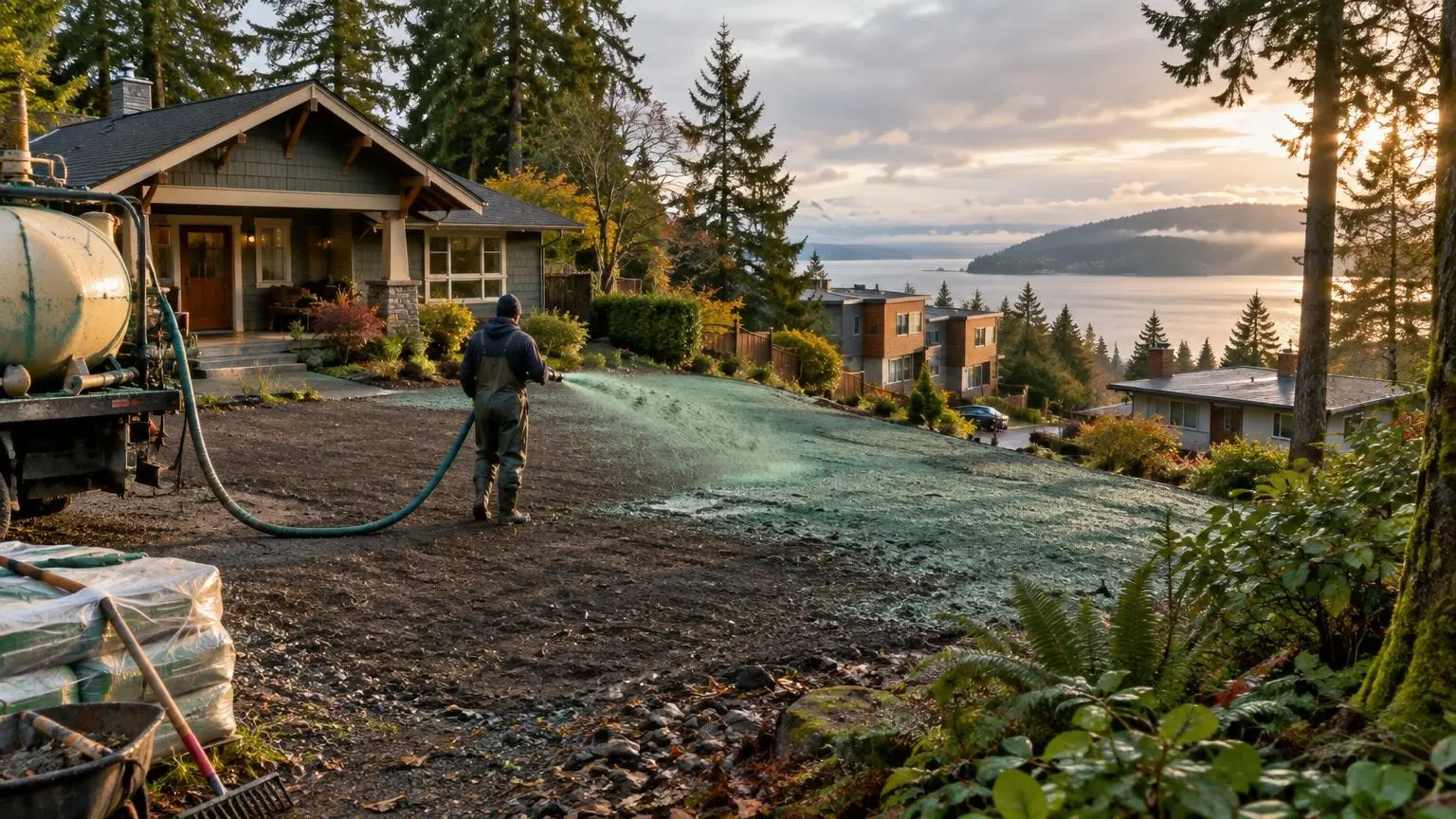
North end of Lake Washington
Hydroseeding in Kenmore, WA
Rolling glacial-till hills split by the Sammamish River, with marshy ground along Swamp Creek.
- We walk your property first, then put the quote in writing at no charge
- Seeding dates planned around Seattle's dry summer and wet winter
- One crew for grading, seeding and sediment control
Kenmore Soil and Seed
Hydroseeding in Kenmore works on terrain typical of the Puget Sound lowlands: rolling hills formed from glacial till, broken by flats near the water. The city lines the northernmost shore of Lake Washington, and the Sammamish River divides it into northern and southern halves. Those two settings, upland till and low lake-edge ground, call for different prep.
Till and drainage
Glacial till can be dense a short way down. The USDA's Alderwood soil series, common on western Washington uplands, is described with a dense layer starting 50 to 100 cm below the surface. If your lot has a profile like that, water perches above the dense layer in winter and lawns can sit wet. We look at how water moves across the yard and may suggest a grading crew cut a shallow drain or reshape the surface before we seed.
Swamp Creek marshland
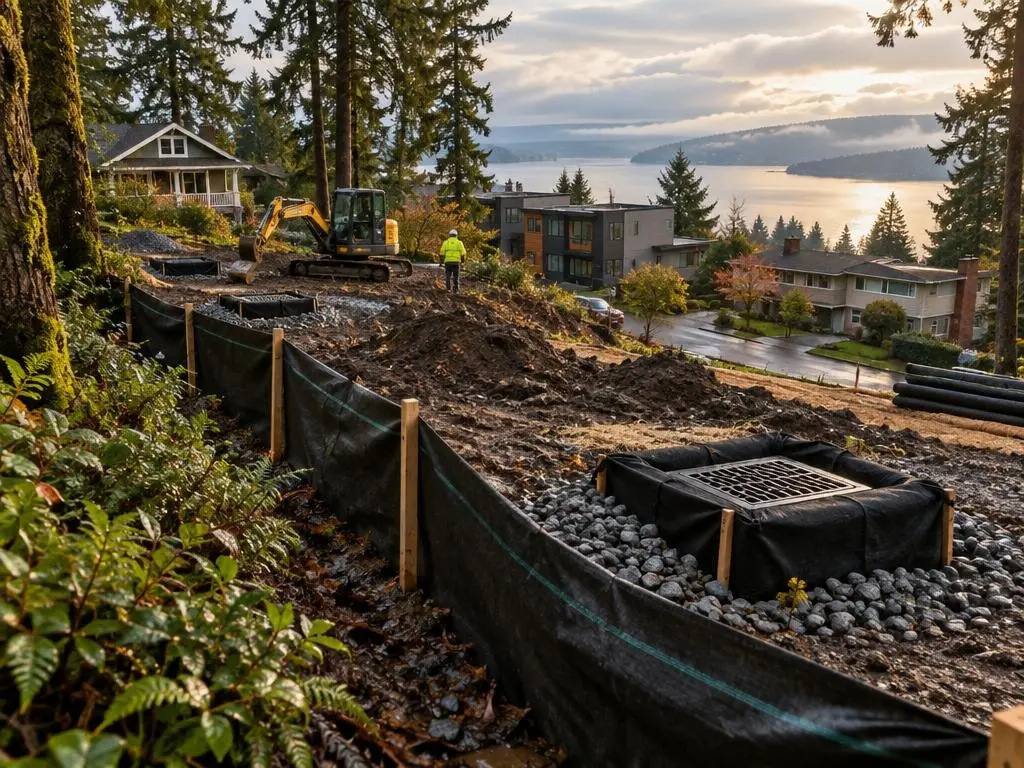
A narrow band of swamps and marshlands runs north to south along Swamp Creek in the northeast corner of the city. Lots near that band need sediment control in place before work starts, and seeding there is about stabilization, not a perfect lawn.
Industrial port and builders
Kenmore keeps one of the last industrial ports on Lake Washington at the river mouth, and its economy includes construction materials such as concrete and asphalt. Commercial and construction hydroseeding for yards, berms and stockpile areas fits that kind of site.
Mid-century plats
Uplake Terrace started in 1953 and Inglewood was first platted the same year, with large-scale suburban building by 1962. Many of those lawns are due for renovation: aeration, topsoil and overseeding, or a full strip and hydroseed.
Kenmore jobs
- Lawn renovation in 1950s and 1960s neighborhoods
- Drainage-aware grading before seeding
- Sediment control near Swamp Creek
- Commercial hydroseeding on industrial sites
Get a free estimate or call (206) 208-7934.
Kenmore Terrain
- Glacial till hills. Kenmore's terrain is rolling hills formed from glacial till, occasionally interrupted by flatlands near large bodies of water.
- River divides the city. The Sammamish River connects Lake Sammamish to Lake Washington and divides Kenmore into northern and southern halves.
- Swamp Creek. A narrow band of swamps and marshlands runs north to south along Swamp Creek in the city's northeast corner.
- Dense subsoil type. The USDA Alderwood series, a western Washington upland soil, has a dense layer 50 to 100 cm below the surface with low conductivity.
Kenmore Questions
Why does my Kenmore lawn stay soggy all winter?
Dense glacial till under a thin topsoil layer can trap water. Regrading, a shallow drain or more topsoil often helps before reseeding.
Can you seed near the Swamp Creek marsh?
Yes, with silt fence first. Near wetlands the aim is stable cover rather than a manicured lawn.
Do you hydroseed industrial yards and berms?
Yes. Berms, stockpiles and open ground on commercial sites are a good fit for hydroseeding.
Is my 1960s lawn worth saving?
If much of it is still grass, overseeding with a topsoil top-dress usually does it. If not, we strip and hydroseed.
Hydroseeding Near Kenmore
- Hydroseeding in Seattle, WA
- Hydroseeding in Bellevue, WA
- Hydroseeding in Redmond, WA
- Hydroseeding in Sammamish, WA
- Hydroseeding in Issaquah, WA
- Hydroseeding in Kirkland, WA
- Hydroseeding in Bothell, WA
- Hydroseeding in Renton, WA
- Hydroseeding in Kent, WA
- Hydroseeding in Auburn, WA
- Hydroseeding in Maple Valley, WA
- Hydroseeding in Covington, WA
- Hydroseeding in Federal Way, WA
- Hydroseeding in Puyallup, WA
- Hydroseeding in Bonney Lake, WA
- Hydroseeding in Snoqualmie, WA
- Hydroseeding in North Bend, WA
- Hydroseeding in Duvall, WA
- Hydroseeding in Enumclaw, WA
- Hydroseeding in Mill Creek, WA
- Hydroseeding in Lake Stevens, WA
- Hydroseeding in Marysville, WA