
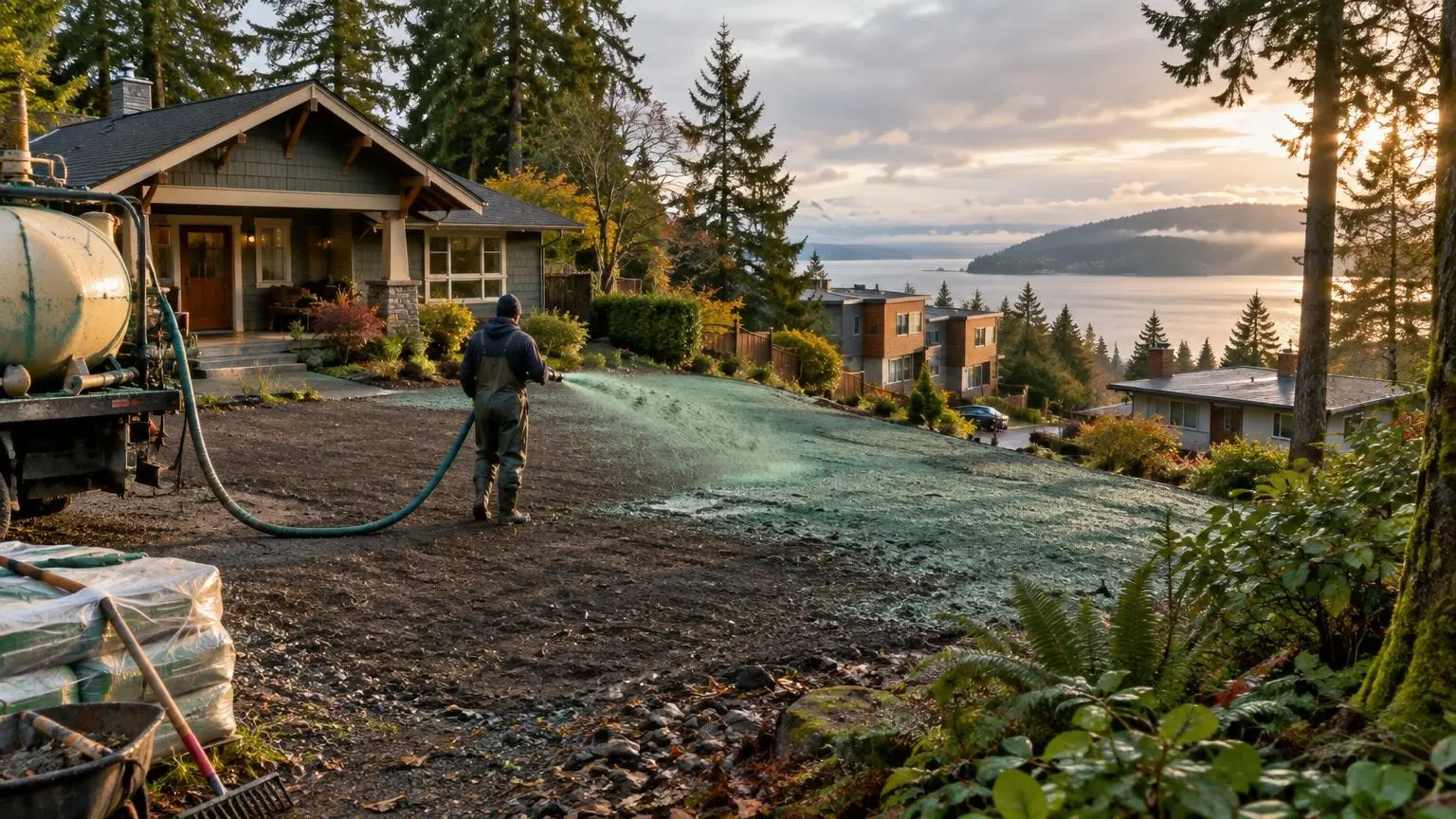
From bare dirt to green in weeks
Hydroseed Lawn Installation in Seattle, WA
Residential lawns seeded with mulch and tackifier, timed for fall rain or backed by a spring watering plan.
- We walk your property first, then put the quote in writing at no charge
- Seeding dates planned around Seattle's dry summer and wet winter
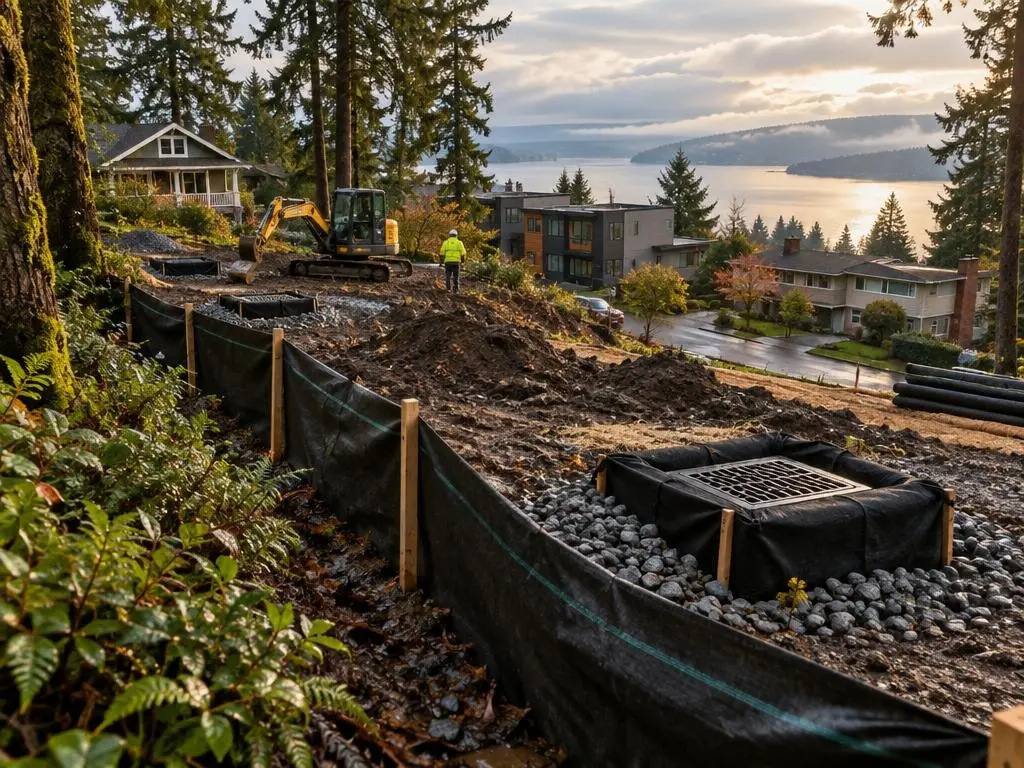
- One crew for grading, seeding and sediment control
Starting a Lawn the Way Seattle Weather Allows
Hydroseed lawn installation in Seattle is the route many Seattle homeowners take from a torn-up yard to grass without paying for sod. After a remodel, a side-sewer replacement, a new house or simply a lawn that has given up, we grade and ready the ground first, and only then spray on seed, fiber mulch, starter fertilizer and tackifier mixed into one slurry. The green tint you see the day we leave is the mulch. Grass usually starts to show within about a week in good conditions, and the mulch keeps the seed damp and in place while it roots. For lawn installation on a budget, or on any yard with a slope, a hydroseed lawn is usually the practical choice.
Fall or spring?
Seattle's driest months fall right in the middle of the growing season, so the date you choose changes how much watering a new lawn needs. Seed laid in early fall, once the heat breaks and the October rains are on their way, gets free irrigation while the soil is still warm. A spring lawn grows just as well but has to be watered through a nearly rainless July and August. We are happy to seed in spring when a project calls for it, and we will be straight with you about the hose time.
Soil depth matters more than seed
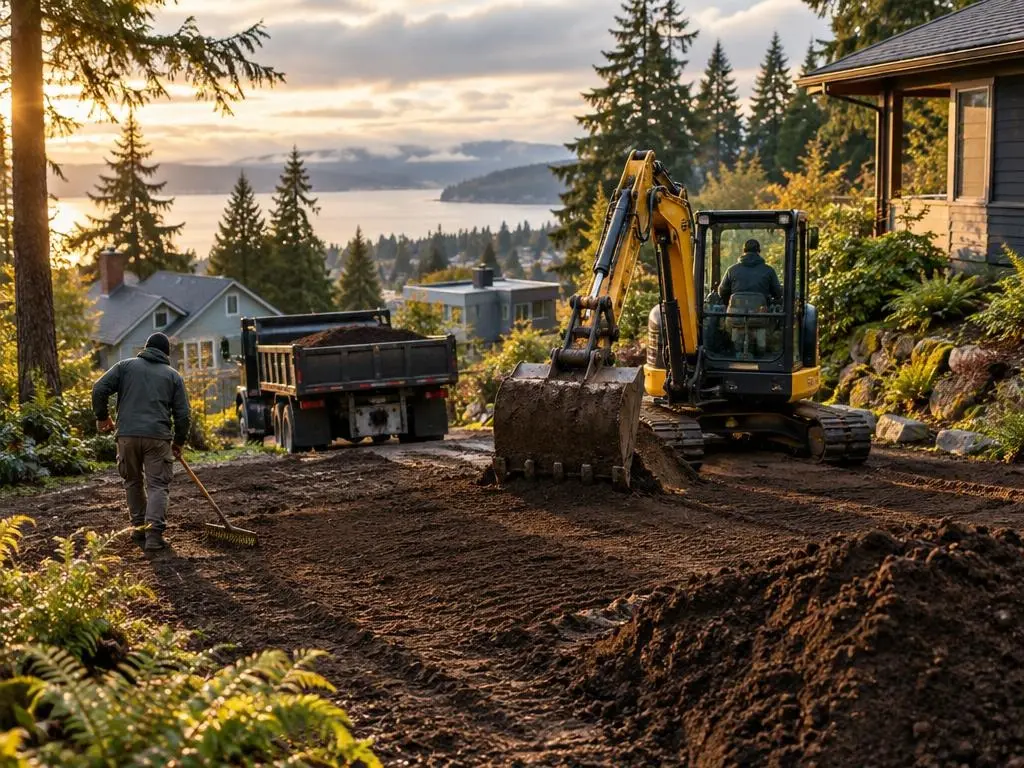
Western Washington upland soils like the Alderwood series are gravelly sandy loam over a dense layer of glacial till, often within 50 to 100 centimeters of the surface. After construction, a yard may have even less: subsoil spread around the foundation and packed down by equipment. Grass roots in that thin layer dry out fast in summer and sit wet in winter. Our first job is to loosen compacted ground and, where needed, spread topsoil so the lawn has real depth to grow into.
Choosing the seed
We use cool-season mixes along the lines WSU Extension recommends for western Washington: mostly turf-type perennial ryegrass, which takes full sun and stands up to traffic, and turf-type tall fescue, which is better adapted to shade. Fine-leaved fescues can be added for color and some extra shade tolerance where the lawn will not see heavy use. Most lawns get a blend, adjusted for sun, shade and whether kids and dogs will be running on it.
WSU also makes a point we repeat to every customer: a new lawn's success depends more on the ground preparation than on whether you choose seed or sod. Soil left after construction is often infertile subsoil with rocks and debris mixed in, and the extension service names sandy loam as the ideal lawn soil.
Hydroseeding cost compared with sod
Hydroseeding cost runs well below sod in every national guide we have seen. HomeGuide puts hydroseeding at twelve to thirty-five cents ($0.12 to $0.35) per square foot, against $1 to $4 per square foot for laid sod. Dry seed is cheaper again, but it is slower to establish and less forgiving on slopes. For a typical new lawn, the soil preparation is often a bigger part of the bill than the seed and mulch.
Lawns on slopes and odd shapes
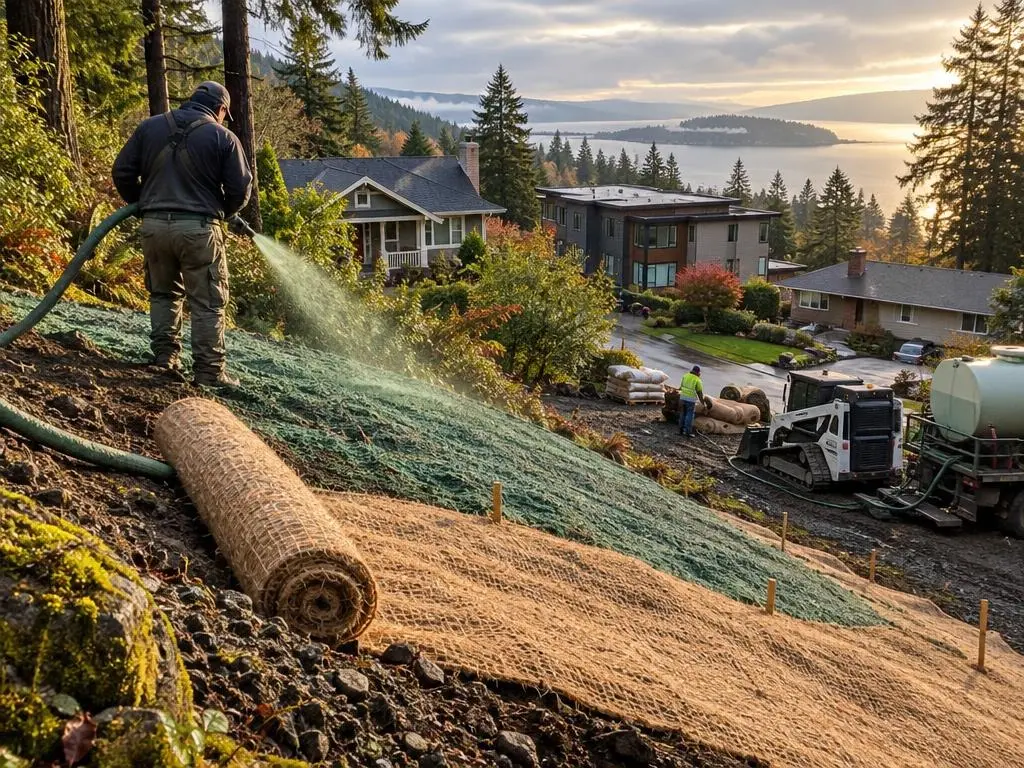
Sod is hard to lay on a tilted yard: the rolls slide, seams open up and the top edge dries out first. Hydroseed goes on as a continuous layer that follows the ground, which is why so many lawns on Seattle's hilly lots are sprayed rather than rolled. On grades too steep to mow comfortably, we may suggest a low-mow mix or a heavier mulch rate, and if water concentrates along a swale, a strip of erosion blanket under the seed.
Water access and timing the spray
Before we book a date, we check that there is a working hose bib or irrigation zone that can reach every part of the new lawn, because the first three weeks decide how well it fills in. We avoid spraying right before a forecast downpour on a bare slope, and in late spring we like to seed early enough that the grass has some roots before the dry weeks of July. If you are going on vacation in the month after seeding, tell us; we will either move the date or talk through a timer setup.
Who we install lawns for
- Homeowners finishing a remodel, addition or side-sewer replacement
- New construction where the builder's scope ends at rough grade
- Yards where the old lawn was mostly moss and weeds
- Planting strips, side yards and backyard cottages on infill lots
Looking after a new hydroseed lawn
Keep the surface damp, not soaked, for the first few weeks, with short waterings once or twice a day in warm weather. Stay off it while it fills in. Plan on the first mow somewhere around four to six weeks in, when the blades stand a few inches high, with the mower set high and the soil firm. A light feeding after the first couple of mows helps it thicken before its first winter. We leave written instructions so nobody has to guess.
What a New Lawn Job Includes
Every residential lawn gets the same core steps; the extras depend on the yard.
Soil loosening and fine grading
We break up compacted construction soil and shape the surface so water drains away from the house.
Topsoil where it is thin
Screened topsoil spread over gravelly or shallow ground to give roots room.
Cool-season seed blend
Perennial ryegrass and tall fescue, with fine fescue where it fits, mixed for your sun, shade and traffic.
Fiber mulch and tackifier
Keeps seed damp through dry spells and stops it from blowing off or rinsing away in rain.
Starter fertilizer
Sprayed in the same pass so young roots have nutrients right away.
Watering and mowing guide
Written instructions for the first weeks, tuned to the season you seed in.
Hydroseeding Cost for Residential Lawns
| Item | Published range |
|---|---|
| Hydroseeding per sq ft (HomeGuide) | $0.12 to $0.35 |
| Hydroseeding per sq ft (Angi) | $0.07 to $0.26 |
| 5,000 sq ft lawn (HomeGuide) | $1,000 to $1,750 |
| Typical minimum job fee (HomeGuide) | $300 to $500 or more |
| Laying sod instead, cost per sq ft (HomeGuide) | $1 to $4 |
| Broadcast dry seed per sq ft, for comparison (HomeAdvisor) | $0.10 to $0.20 |
Published third-party ranges, not a Seattle price sheet of ours: square footage, grade, how close we can park and your soil's condition all shift the total. National guide figures; your price is whatever we put in writing after measuring.
From Site Visit to First Mow
1. Walk the yard
We look at soil depth, drainage, shade and access, then send a written estimate.
2. Prepare the ground
Debris out, compaction loosened, topsoil added where needed, and the surface fine graded.
3. Spray the slurry
Seed, mulch, fertilizer and tackifier go on in overlapping passes for even coverage.
4. Water and wait
You keep it damp for the first weeks; sprouts usually show within about a week in good conditions.
5. First mow
Around four to six weeks, with the mower set high and the soil firm.
Why Choose Us for Hydroseed Lawn Installation
Honest timing advice
We tell you whether your date rides the fall rains or needs summer watering.
Prep comes first
We would rather add topsoil than spray good seed onto packed subsoil.
Shade-aware mixes
Yards under conifers get a more shade-tolerant fescue blend so the lawn does not thin out.
Hydroseed Lawn Installation Questions
How much should I budget to hydroseed a Seattle lawn?
HomeGuide's national figures run $1,000 to $1,750 for a lawn of roughly 5,000 square feet, and Angi lists $0.07 to $0.26 per square foot. Topsoil, grading and slope change the total. After we see the yard you get a written quote, and that quote is what you pay.
How long until a hydroseed lawn looks like a lawn?
Sprouts usually show within about a week in warm, moist conditions, and the first mow comes at roughly four to six weeks. It takes a full season of mowing and feeding to look thick and settled.
Is hydroseed or sod better for a small city lot?
Sod is faster to look finished, but per square foot it runs several times the price of hydroseed and needs heavy watering to root in summer. Hydroseed is the better value on most lots, especially anything with a slope or an odd shape.
Can you hydroseed in summer?
Yes, but only with a solid watering plan, because July and August are very dry here. Many homeowners wait for early fall instead.
Will moss come back in a new lawn?
Moss moves in where turf is thin, shaded or sitting wet. Good soil depth, drainage and a shade-tolerant mix give the grass the upper hand.
Hydroseed Lawn Installation Service Areas
- Hydroseeding in Seattle, WA
- Hydroseeding in Bellevue, WA
- Hydroseeding in Redmond, WA
- Hydroseeding in Sammamish, WA
- Hydroseeding in Issaquah, WA
- Hydroseeding in Kirkland, WA
- Hydroseeding in Bothell, WA
- Hydroseeding in Kenmore, WA
- Hydroseeding in Renton, WA
- Hydroseeding in Kent, WA
- Hydroseeding in Auburn, WA
- Hydroseeding in Maple Valley, WA
- Hydroseeding in Covington, WA
- Hydroseeding in Federal Way, WA
- Hydroseeding in Puyallup, WA
- Hydroseeding in Bonney Lake, WA
- Hydroseeding in Snoqualmie, WA
- Hydroseeding in North Bend, WA
- Hydroseeding in Duvall, WA
- Hydroseeding in Enumclaw, WA
- Hydroseeding in Mill Creek, WA
- Hydroseeding in Lake Stevens, WA
- Hydroseeding in Marysville, WA
Get a Hydroseed Lawn Installation Estimate
Free site visits for new hydroseed lawns in Seattle.